Free task manager for a team: a simple way to start

A free task manager is not about collecting the most features for no money. It should help a team agree on three everyday things: what needs doing, who owns it and when the result is due.
This article is written by the iTasker team. Limits were checked against the official pricing information on October 20, 2026. We are discussing the ongoing free plan, not promising free access to every paid feature.
What a free team task manager should do
Test an ordinary working day rather than a long feature list on a landing page.
- Can you capture an assignment where the conversation happens?
- Are its owner and deadline clear?
- Can everyone find their current tasks?
- Is there a shared overview for the manager?
- Is it clear which limit would require an upgrade?
If you still have to assemble a separate chat report every time, the tool has not yet solved the main problem.
What iTasker Free includes
| Feature | Free allowance | What it means for the team |
|---|---|---|
| Projects | 2 per organisation | Separate two workstreams |
| Members | Up to 5 per project | A small working group fits in one project |
| Assignees | 1 per task | Each assignment has one owner |
| Incoming tasks | Up to 10 per project | An incoming-task limit, not a cap on all project tasks |
| Active reminders | 5 | Reserve reminders for important follow-ups |
| AI requests | Up to 5 per day and 50 per month | A limited allowance for AI-assisted input |
The daily and monthly AI limits apply together: “5 per day” does not mean 150 requests per month. Other features have limits too, including file size and storage. Check the full plan details before making the tool part of your routine.
The web board shows work moving between stages, and the browser calendar shows deadlines. Syncing project tasks with Google Calendar and exporting CSV are paid features. Do not confuse those with the free views inside iTasker.
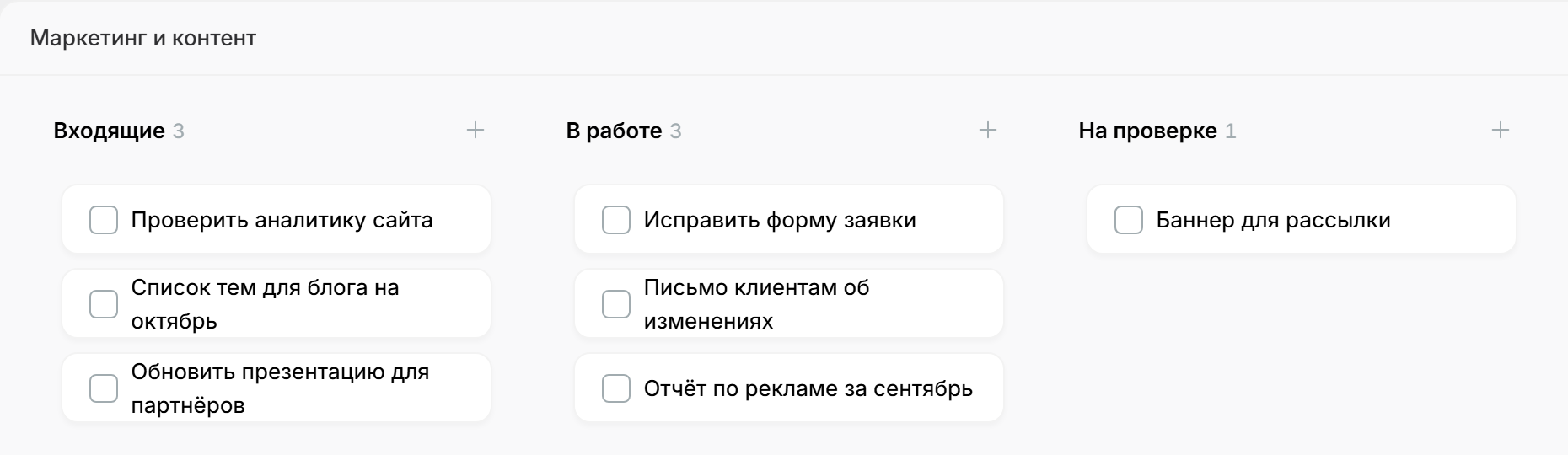
A real iTasker web-board screenshot from our Kanban guide, with the interface in Russian. Clear stages matter more than a large number of columns.
An example: a four-person studio
Imagine a small studio. Its manager talks to clients, a designer creates layouts, an editor writes copy and an assistant gathers source material.
One project is enough to begin. “Prepare the landing-page hero” gets a designer, a due date and a short description of the expected result. The discussion can continue in Telegram while the team checks progress in the web app.
Five project members does not mean five assignees on every task. If several people contribute to an outcome, the free plan can support separate assignments with one owner each. If you specifically need one card with multiple assignees, evaluate a paid plan.
When the free plan is enough
It is enough when the team fits within the limits without spending time working around them. One small project, four members, clear assignments and occasional reminders are a reasonable starting scenario.
Consider a paid plan when you need more than two projects, more than five members in one project or paid integrations. That is a normal change in your workflow. Notice it early instead of building the process around awkward workarounds.
Get started without a complicated setup
We suggest starting with free iTasker if Telegram is already your team's working chat. The first benefit comes from recording agreements consistently, not from a complicated setup.